

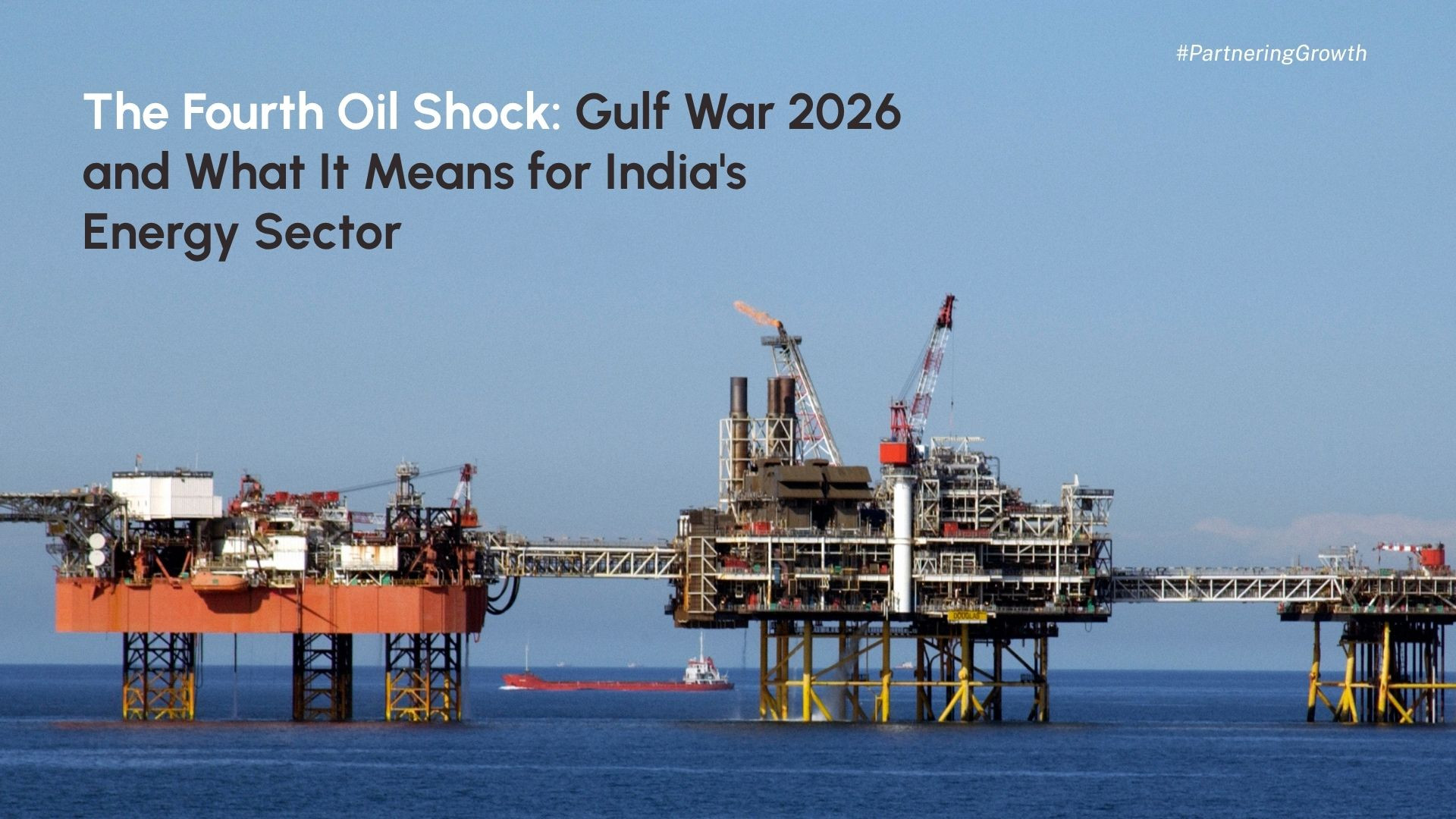
The head of the International Energy Agency described the current situation as the "greatest global energy security challenge in history", a characterisation that would have seemed hyperbolic six months ago, but now appears measured given the scale of disruption. For India's energy sector, the Gulf War of 2026 is not a distant geopolitical event. It is a direct operational shock that is reshaping procurement economics, policy responses, and the medium-term investment calculus across the energy sector.
India imports over 85% of its crude oil and approximately 50% of its natural gas requirements, with a large share of both routed through the Strait of Hormuz. As per the Ministry of Petroleum and Natural Gas (MoPNG), the country's strategic crude reserves as of late March 2026 cover approximately 45 days of consumption, well below the 90-day benchmark mandated for International Energy Agency membership, which India aspires to.
Crude Oil: Import Bill, CAD, and Downstream Pressure
Brent crude prices rose approximately 40% within two weeks of the Hormuz closure, crossing $110–120 per barrel, as per the IEA March 2026 Oil Market Report. For India, the consequences are immediate and multilayered.
The import bill for crude oil, already India's single largest import commodity, expands sharply in dollar terms. Compounded by the rupee weakening to above ₹90/USD, the rupee cost of every barrel is significantly elevated. The World Economic Forum's March 2026 analysis noted that India, with thinner foreign reserves and heavy reliance on Middle Eastern crude, is more vulnerable to a prolonged disruption than major Asian peers such as China.
For Oil Marketing Companies (OMCs) such as IOC, BPCL, and HPCL, the central question is the government's retail pricing posture. The government has so far held petrol and diesel prices unchanged, as per MoPNG's March 2026 statements, while raising LPG cylinder prices by ₹60. This means that refining margins are absorbing the crude cost spike, a situation that may be financially sustainable for a few weeks but becomes increasingly strained if crude remains elevated for a quarter or more.
LNG and Natural Gas: The Deeper Vulnerability
If crude is the headline shock, LNG is the deeper structural vulnerability. Qatar supplies approximately 50% of India's LNG, as per PPAC data. With QatarEnergy having declared force majeure on all exports following strikes on the Ras Laffan industrial complex, Indian gas supply chains are under acute stress.
City Gas Distribution (CGD) networks, fertiliser plants, and gas-based power generation are all impacted. India invoked emergency powers to redirect LPG from industrial users to households shortly after the crisis began, as reported by Reuters in early March 2026. Industrial users, including chemicals, ceramics, and food processing, are receiving only Tier 2 priority allocation, equivalent to approximately 70% of contracted volumes.
India's options for LNG diversification are real but not immediate. GAIL has existing long-term agreements with Gazprom (Russia) and with suppliers in Australia and the United States. However, as Business India's March 2026 analysis noted, the quantum of Russian LNG that can be diverted to India on short notice is limited, and spot procurement from Australia or the US West Coast incurs significant freight costs and adds to the timeline.
Power Sector: Generation Mix Under Stress
Gas-based power plants in India operate at low plant load factors even in normal times given the cost disadvantage versus coal. With gas prices now sharply elevated, these plants are even less competitive in the merit order. The practical consequence is greater dependence on coal-based generation and to the extent that coal supply and logistics permit, a modest increase in coal plant utilisation.
For the power sector as a whole, the more significant concern is inflation in electricity costs. Elevated gas and coal prices are being passed through to power purchase costs, putting Distribution Companies (DISCOMs), already carrying accumulated losses of over ₹6 lakh crore as per the Ministry of Power's UDAY/RDSS scheme data, under additional financial stress. State electricity regulatory commissions will face early pressure to revise tariffs, a politically sensitive outcome that has historically been deferred.
Renewables: Short-Term Supply Chain Disruption, Long-Term Acceleration
The renewables sector faces a different impact profile. In the short term, solar panel supply chains are being disrupted, not primarily through the Gulf, but through broader supply chain dislocations and shipping cost inflation triggered by the conflict globally. According to IEA projections referenced in the WEF March 2026 analysis, higher fuel, freight, and insurance costs are raising the prices of solar panels, batteries, and wind components.
However, the medium to long-term signal is unambiguously positive for renewables investment. Every major oil shock in history, 1973, 1979, and the post-Ukraine disruption of 2022, accelerated the diversification away from fossil fuel dependence. The current crisis is likely to intensify India's already ambitious targets for renewable capacity addition and accelerate the policy push for domestic solar manufacturing under the Production Linked Incentive (PLI) scheme and the Approved List of Models and Manufacturers (ALMM) framework.
Policy Response and Energy Security Measures
The government has moved on multiple fronts simultaneously. Beyond the slab-based LNG pricing mechanism, the government has proposed mandating an additional 10% LNG storage at terminals for emergency use, though this proposal remains under review. Strategic crude reserves are being reviewed to accelerate the build-out beyond the existing facilities at Visakhapatnam, Mangalore, and Padur.
The government has also reinforced biofuel blending mandates, with higher ethanol blending beyond E20 being explored, as per Business India's analysis, as an immediate measure to partially offset petrol demand. These steps reflect the recognition that the current crisis is not merely a price event but a supply-security challenge that requires structural responses.
What the Sector Should Expect
In the near term, the energy sector faces a difficult combination: elevated input costs, limited ability to pass costs through to retail consumers in the short run, and working capital pressure on gas-dependent businesses. OMCs are in the most immediately stressed position; gas utilities and CGD companies are managing allocation constraints; power DISCOMs face the compounding pressure of higher generation costs on top of pre-existing balance sheet stress.
The medium-term outlook will depend significantly on how quickly alternative LNG supply lines are secured, whether the Hormuz situation stabilises or escalates, and how the government calibrates the trade-off between protecting consumers from price inflation and allowing market signals to adjust energy demand. These are precisely the kinds of structural shifts that the energy sector's financial planning assumptions, built around a very different supply environment, did not anticipate.
It would be interesting to understand practitioners' and finance leaders’ perspectives on how they approach planning horizons and capital allocation in this environment.

 Uploaded On:
  Author: