

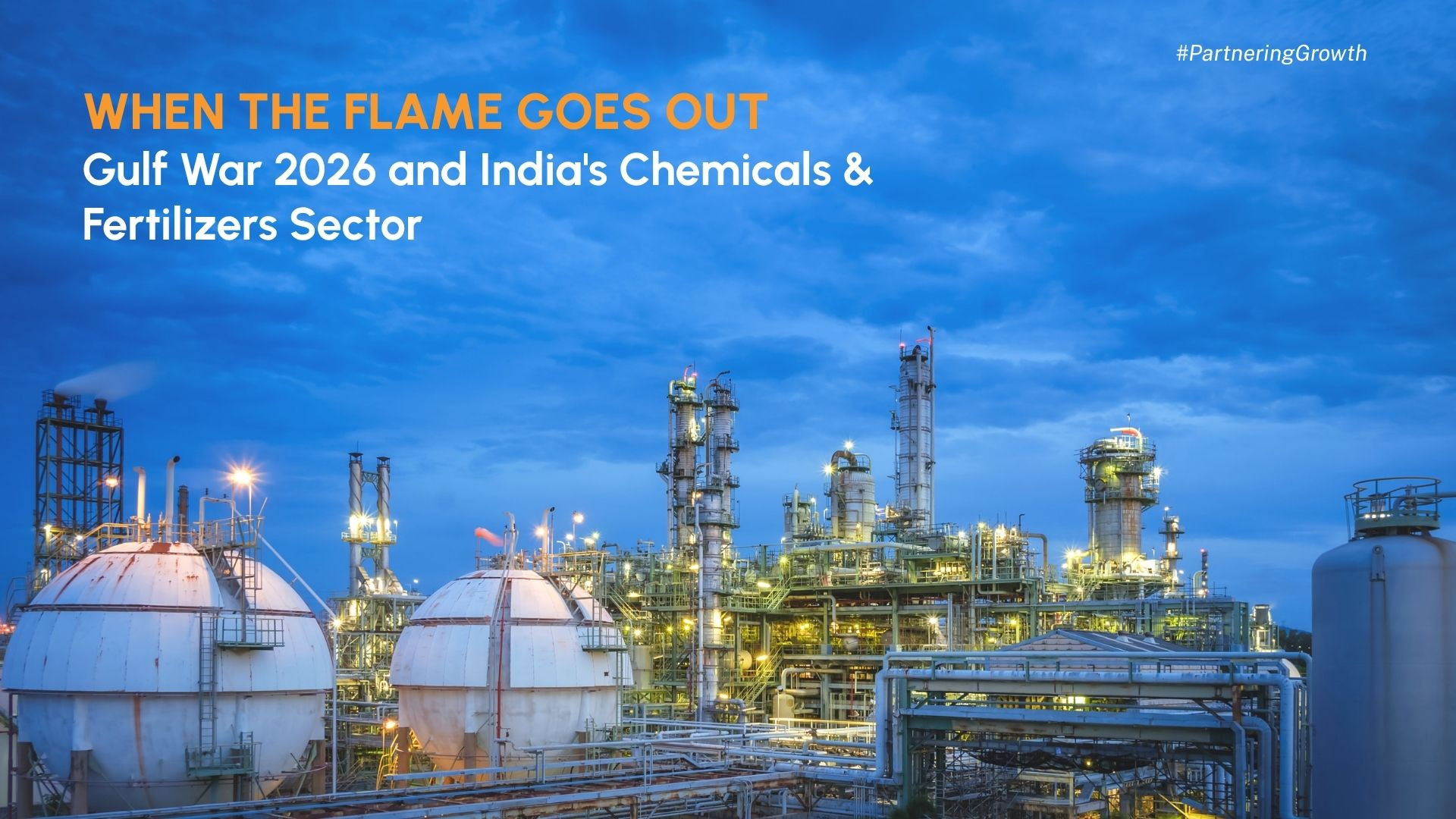
The closure of the Strait of Hormuz on 4 March 2026 was not merely an energy headline. For India's chemicals and fertilizers industry, it was the equivalent of switching off a critical feedstock pipeline. Natural gas, specifically liquefied natural gas (LNG), is the backbone of this sector: it is the raw material for ammonia and urea, the fuel for energy-intensive chemical manufacturing, and the key determinant of margins for an industry already navigating elevated post-pandemic cost structures.
The pressure is arriving simultaneously from supply, pricing, government intervention, and export competitiveness, making this one of the more complex operating environments the sector has faced in recent years.
The LNG Supply Shock
India imports approximately 50% of its LNG from Qatar, as per the Petroleum Planning and Analysis Cell (PPAC). With the Strait of Hormuz effectively closed following Iran's retaliatory actions, QatarEnergy has declared force majeure on all exports. The Strait, through which nearly 20% of global LNG flows according to the International Energy Agency (IEA), remains inaccessible as of late March 2026.
For companies with long-term LNG supply agreements, the situation poses two simultaneous challenges: physical unavailability of contracted volumes and contractual ambiguity regarding obligations when supply cannot be delivered.
Government Slab-Based LNG Pricing: A Double-Edged Intervention
The Government of India has responded with a tiered LNG allocation mechanism that prioritises household cooking gas and fertiliser manufacturers, while placing industrial chemical producers in Tier 2, with Tier 2 receiving approximately 70% of their contracted requirements. This intervention, while necessary from a food and energy security standpoint, has created a significant asymmetry within the sector itself.
Fertiliser manufacturers, particularly urea producers, receive preferential feedstock access, but face a different constraint: the government's Maximum Retail Price (MRP) for urea remains capped under the Urea Control Order, while production costs have surged sharply with the LNG price spike. According to the Fertiliser Association of India (FAI), LNG accounts for roughly 70–75% of the variable cost of urea production. The resulting gap between production costs and recoverable MRP flows through to the government subsidy mechanism, but subsidy disbursements under the Department of Fertilisers have historically lagged actual expenditure by 3 to 6 months, creating working capital pressure in the interim.
For speciality chemical and dye manufacturers in Tier 2, the choice is starker: procure gas from spot markets, where Asia LNG spot prices have doubled and accept severe margin compression, or curtail production and lose order commitments.
Margin Compression Across the Value Chain
Natural gas is both a feedstock and an energy source for this sector, making the impact compounding rather than additive. As per ICRA's March 2026 sector update, ammonia and urea plants are operating at 60-70% capacity, with downstream chemical production chains, including methanol, acetic acid, and chlor-alkali, similarly affected.
Energy-intensive processes such as calcium carbide production, industrial gas manufacturing, and certain agrochemical intermediates are estimated to have seen energy cost escalation of 30-40%, directly compressing EBITDA margins. Speciality chemical exporters, who had been gaining ground as global buyers sought to reduce China’s supply dependence, are now facing a situation in which cost competitiveness has eroded precisely as order pipelines were building.
Export Competitiveness: Momentum Interrupted
India had been making measurable progress as a speciality chemicals exporter, which is now under pressure from two directions.
On the supply side, elevated feedstock costs are making it difficult for Indian producers to offer internationally competitive prices on export contracts. On the demand side, European buyers, who had been actively diversifying their chemical supply chains away from China, are re-evaluating procurement decisions in a market where everyone's costs are elevated.
The rupee's depreciation to beyond ₹90/USD helps export realisations in rupee terms, but the benefit is largely offset by dollar-denominated LNG and feedstock import costs. Ultimately, the currency-related export margin improvement is marginal for most companies.
Fertiliser Supply and Food Security Risk
Beyond the immediate industrial impact, there is a broader concern about the availability of agricultural inputs, with a significant portion of global fertiliser exports transiting the Strait of Hormuz. Qatar, which halted production at its largest urea manufacturing plant at Ras Laffan, is a significant global exporter of urea and ammonia.
India's domestic urea production, while substantial, does not fully meet agricultural demand. Any shortfall in imported fertilisers heading into the Kharif sowing season (June-July) could translate into higher agricultural input costs and, by extension, food price pressures, an outcome the government will be watching closely.
The Broader Picture
The current crisis is exposing India’s structural vulnerability: dependence on import of natural gas, with over 50% of LNG supplies routed through a single chokepoint. For the chemicals and fertilisers sector, this is not merely an operational challenge; it raises fundamental questions about feedstock security, long-term cost competitiveness, and the viability of capacity expansion plans that were predicated on a stable and affordable gas supply.
Companies that had been planning capacity additions in ammonia, speciality chemicals, or agrochemicals will need to reassess their investment timelines and financing assumptions. The sector's growth story over the past three years was built largely on the premise of India as a cost-competitive global chemicals hub, a premise that the current supply shock puts under meaningful strain.

 Uploaded On:
  Author: