

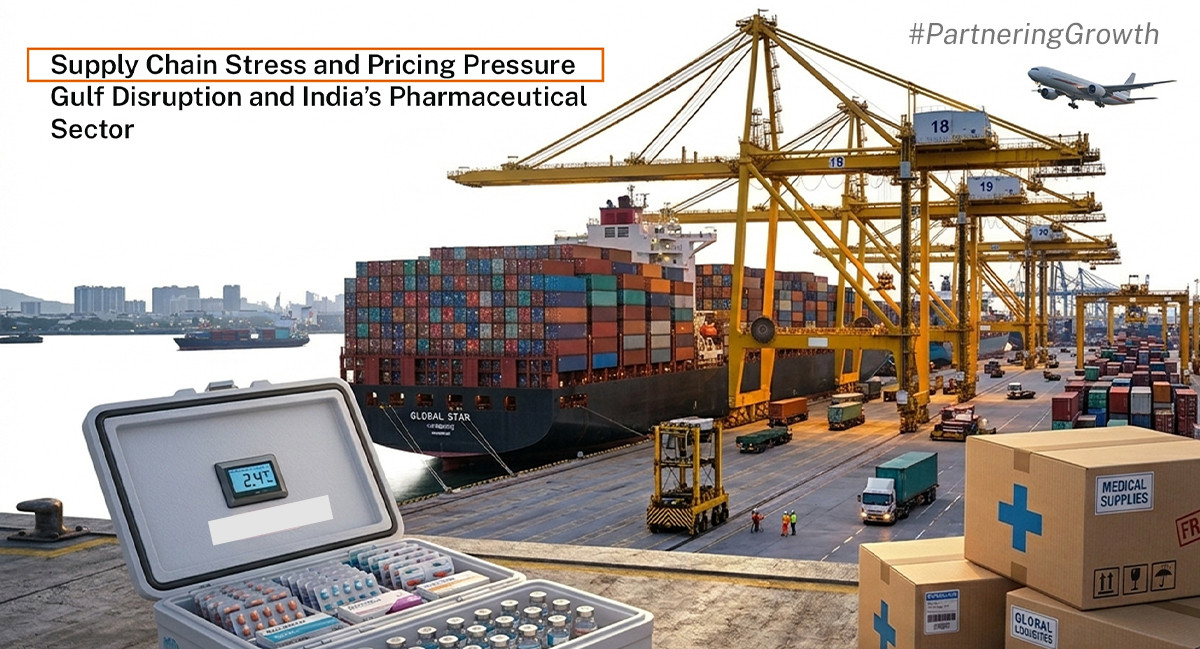
The ongoing geopolitical disruption in the Gulf region is beginning to affect India’s healthcare and pharmaceutical sector through a combination of supply chain constraints, input cost pressures, and logistics uncertainties. As a globally integrated industry with strict regulatory and timing requirements, even moderate disruption in the movement of inputs or finished goods can have a disproportionate operational impact.
At the same time, the current environment is interacting with existing structural dependencies in the sector, particularly around the sourcing of Active Pharmaceutical Ingredients (APIs) and export market pricing dynamics.
API Supply Chains: Beyond the Gulf
India’s pharmaceutical manufacturing relies significantly on imported APIs and intermediates. While logistics disruptions linked to global trade routes may affect transit timelines, a broader vulnerability lies in India’s dependence on China for bulk drug imports, estimated at approximately 65–70% as per data from the Ministry of Chemicals and Petrochemicals and Pharmexcil.
Even where production geographies remain unaffected, tightening shipping capacity and logistics uncertainty can influence the availability and timing of API supplies. Delays in input availability may interrupt production schedules, particularly for specialised formulations where alternate sourcing requires regulatory approvals.
Air Freight Disruption and Cold-Chain Risk
The pharmaceutical sector is particularly dependent on air freight for high-value and time-sensitive products such as biologics, vaccines, and temperature-controlled shipments.
Where airspace constraints or rerouting of cargo flights arise, transit times may be extended and cargo capacity may be reduced. This can create operational challenges beyond delays. Extended transit increases the risk of temperature excursions in cold-chain logistics, additional handling requirements, and higher freight costs.
For products with strict stability requirements, these factors can affect product usability and regulatory compliance.
Input Cost Pressure: Packaging and Energy Linkages
The sector is also exposed to rising input costs, particularly in packaging materials derived from petrochemicals. Where crude-linked input costs increase, materials such as plastic containers, blister packs, and medical-grade polymers may become more expensive.
While packaging is not the largest cost component, regulatory requirements limit flexibility in substitution, making it difficult to offset cost increases quickly. This can add incremental pressure on margins, particularly in segments where pricing is contractually fixed.
Export Pricing Pressure in Regulated Markets
A key dimension often less visible is pricing rigidity in major export markets such as the US and EU. Indian pharmaceutical exporters typically operate under long-term supply contracts, tenders, or regulated pricing frameworks where price revisions are not immediate.
As input and logistics costs increase, the ability to pass through these changes may remain constrained. This can create margin pressure even in markets where demand remains stable. Industry commentary, including IBEF sector analyses, highlights that pricing flexibility in regulated markets remains limited despite cost volatility.
Selective Export Opportunity
At the same time, global buyers may reassess supply chain diversification in response to geopolitical uncertainty. As noted in Deloitte Insights analysis (March 2026), such disruptions can accelerate sourcing shifts toward established manufacturing hubs.
India, with established regulatory approvals and manufacturing scale, remains positioned to benefit from such shifts. However, the ability to capture incremental demand depends on maintaining supply reliability and operational continuity.
Closing Perspective
The pharmaceutical sector operates at the intersection of global supply chains, regulatory discipline, and time-sensitive delivery. Disruptions in logistics and input availability can translate quickly into production, compliance, and financial considerations.
In this context, balancing supply continuity, cost pressures, and contractual constraints becomes critical. It would be useful to understand how practitioners in the sector are approaching these trade-offs.

 Uploaded On:
  Author: