

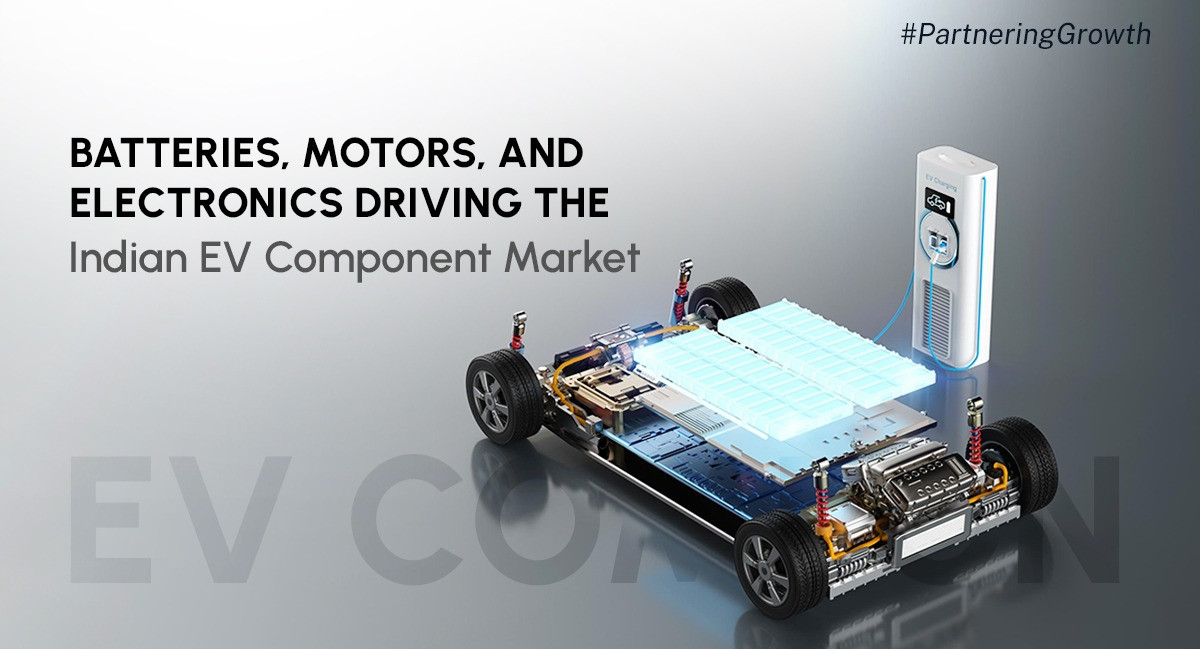
The Indian electric vehicle (EV) component market is witnessing rapid expansion as of 2025, fueled by accelerating EV adoption, government incentives, and advances in battery technology, electric motors, and power electronics. Together, these components form the backbone of India's growing EV ecosystem, enabling sustainable mobility and industrial growth.
Market Size and Growth
Valued at approximately USD 4 billion in 2024, the Indian EV component market value stands at approximately USD 4.67 billion in 2025, projected to expand at a CAGR of 17.3% during 2025–2033. This growth mirrors the demand for high-performance batteries, efficient motors, and smart electronics critical to electric two-wheelers, three-wheelers, and passenger vehicles, which dominate the Indian EV landscape.
Batteries: The Leading Component
Batteries are set to represent nearly 60% of the component market revenue by 2027, driven predominantly by increasing lithium-ion adoption. Efforts to scale up domestic battery manufacturing are underway, aiming to enhance battery energy density, shorten charging times, and reduce costs. The lithium-ion battery market is forecasted to grow from USD 16.8 billion in 2023 to USD 27.7 billion by 2028 in India.
India’s lithium-ion battery manufacturing capacity is projected to grow significantly to 150 GWh by 2030, driven by the government’s Production-Linked Incentive (PLI) scheme for Advanced Chemistry Cell (ACC) manufacturing. To achieve this target, investments exceeding ₹75,000 crore (approximately USD 10 billion) have already been committed by public and private sector players.
Electric Motors and Power Electronics
Electric motors contribute roughly 15% of the market revenue. Indian manufacturers focus on improving the efficiency and durability of motors, particularly for two- and three-wheeler segments. Similarly, power electronics, also about 15% of the business, drive energy flow management and incorporate advanced features like 800V systems, enabling faster and more efficient charging.
Regional Investments and Industrial Clusters
Key states like Tamil Nadu have emerged as manufacturing hubs with investments around ₹50,000 crore (USD 5.8 billion), generating an estimated 150,000 jobs. These investments enhance India’s EV component ecosystem by creating robust supply chains and technological capabilities.
Among states, Gujarat leads the charge as India’s largest battery manufacturing hub. It hosts India’s first lithium-ion cell plant by Toshiba Denso Suzuki in Hansalpur with a capacity of about 1 GWh, alongside Tata Chemicals’ planned 10 GWh facility and Reliance’s proposed Jamnagar gigafactory.
Telangana is another major centre, housing large-scale projects by Exide, Amara Raja, and others, with a combined capacity estimated between 16 and 18 GWh, positioning it as an emerging gigafactory hub. Tamil Nadu is also building capacity of roughly 2,000 MWh, primarily focused on battery pack manufacturing and assembly. States such as Haryana, Maharashtra, and Uttar Pradesh are home to smaller manufacturers and assembly units, including Pastiche Energy Solutions (Panchkula), Fusion Power Systems (Gurugram), Maxvolt (Noida), and Vision Mechatronics (Pune), which contribute to both cell production and battery pack assembly.
Currently, much of India’s installed capacity is concentrated on battery pack assembly, while cell manufacturing remains at an early but fast-growing stage. Leading players in the space include Reliance, Tata Chemicals, Exide, Amara Raja, Ola Electric, Lucas-TVS, and emerging startups like GODI. The government’s revised PLI ACC scheme aims to accelerate this growth by offering financial incentives to manufacturers establishing a minimum of 5 GWh of cell manufacturing capacity, fostering a robust and competitive domestic supply chain for India’s clean energy transition.
Challenges and Future Outlook
While opportunities abound, the market faces challenges, including raw material dependencies, charging infrastructure gaps, and a skilled workforce shortage. India’s goal of 30% EV penetration by 2030 underlines long-term growth potential, supported by rising consumer demand for cleaner transportation.

 Uploaded On:
  Author: