

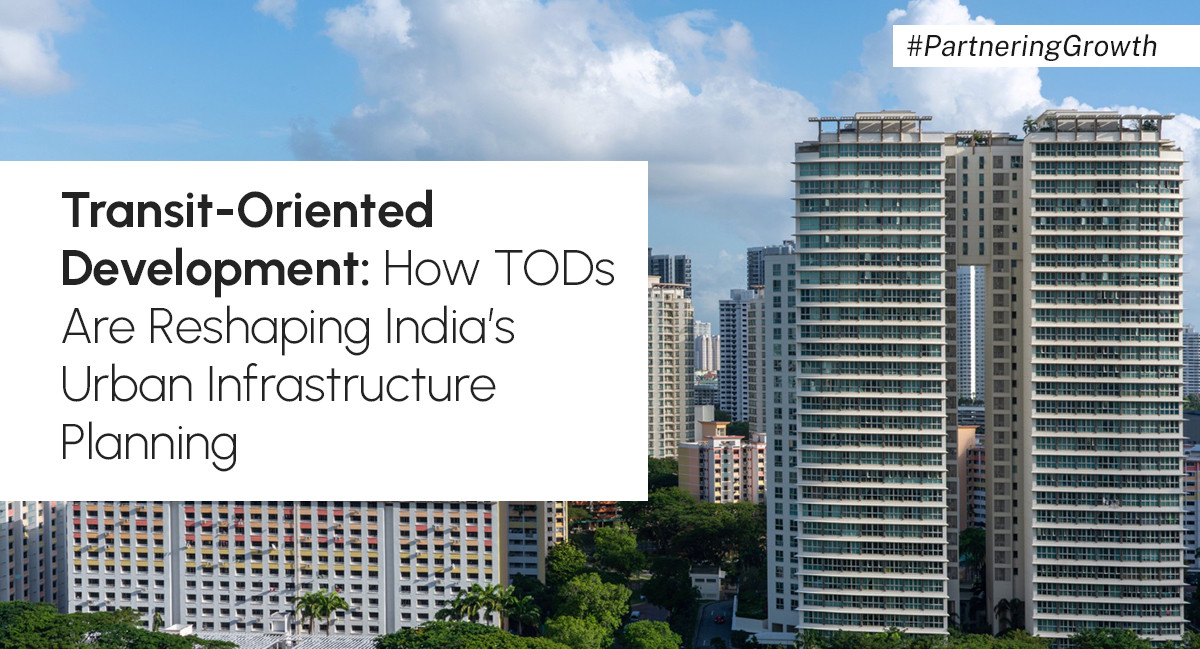
Transit-Oriented Development (TOD) has moved from an urban-planning concept to a financial and regulatory priority. For teams responsible for evaluating project viability, capital allocation, and compliance, TODs reshape the entire risk-return equation of urban infrastructure.
Recent updates from the Ministry of Housing and Urban Affairs, along with ongoing 2025 metro expansion discussions, indicate a stronger emphasis on embedding Transit-Oriented Development (TOD) principles into how new metro corridors are being structured and appraised. While the National TOD Policy remains the foundational guideline for station-area development, its influence is becoming more visible in financing conversations—particularly around land monetisation potential, cost structuring, and long-term revenue modelling. In my view, this signals a gradual shift in metro project evaluation, where integrated land-use and transport planning is starting to shape financial feasibility more directly than in previous project cycles.
How TOD Corridors Are Reshaping Land Valuation and Financial Structuring in Urban Projects
TOD zones typically unlock higher land values along operational corridors. For financial planning teams, this directly impacts:
⦿ Development premiums and land valuation models
⦿ Sensitivity analysis for FSI-enhanced projects
⦿ Working capital tied to sequencing, rezoning, and multi-use approvals
Cash-flow projections in TOD projects require closer synchronisation with transit construction timelines. Lenders have begun linking debt drawdowns to metro progress milestones, reflecting the heightened regulatory and execution risk inherent in TOD ecosystems.
Regulatory & Compliance Intersections
TODs sit at the intersection of several compliance frameworks — RERA, environmental clearance norms, municipal zoning laws, and digital building approval systems. For teams overseeing reporting and regulatory alignment, this means:
Multi-tower revenue recognition must reflect mixed-use phasing
Capitalisation of transit-linked public infrastructure requires policy-aligned treatment
Financial disclosures must incorporate TOD-driven premiums and contingent risks
As MoHUA intensifies its push for multimodal integration hubs, TOD-driven development will increasingly affect municipal balance sheets, SPV structures, and land pooling mechanisms.
Economic Stakes
Congestion costs currently reduce urban productivity significantly; research studies estimate a drag of approximately 1% of urban GDP every year. TODs offer a direct macroeconomic gain by compressing travel time, lowering energy use, and improving workforce productivity — all factors that influence state-level GDP growth and tax revenue stability.
What Lies Ahead
With NHAI and the Ministry of Housing and Urban Affairs jointly evaluating multimodal integration hubs, TOD corridors will increasingly converge with bus rapid transit, suburban rail, and regional rapid rail systems. This integration is occurring at a time when central allocations to urban transport have scaled meaningfully.
The Union Budget 2025–26 earmarked ₹34,807 crore for metro and urban transport, a substantial rise from ₹5,798 crore in FY2013–14, reflecting how transit infrastructure is being framed as a long-horizon economic asset rather than a standalone mobility investment. Cumulatively, metro investments have now crossed ₹5 lakh crore across India, with 1,035.74 km operational as of October 2025 and another 779 km under construction, marking one of the fastest expansions of any emerging-market urban transit system.
Annual ridership has reached 3.65 billion passengers, supporting nearly 10 million daily commuters — an operational scale that naturally demands more rigorous financial planning, transparent cost allocation, and stronger cross-agency reporting norms.
In my view, the next phase of TOD success will depend on how transport agencies and urban local bodies coordinate not only on design and corridor planning but also on budget synchronisation, revenue-sharing clarity, and land monetisation governance. As TOD-linked investments grow in scale, the financial community will increasingly expect structured disclosures, lifecycle-cost visibility, and clearer risk apportionment across agencies. This is where disciplined financial modelling and robust capital-planning frameworks will play a decisive role in determining whether TOD becomes a sustainable financing mechanism rather than an aspirational planning tool.

 Uploaded On:
  Author: