

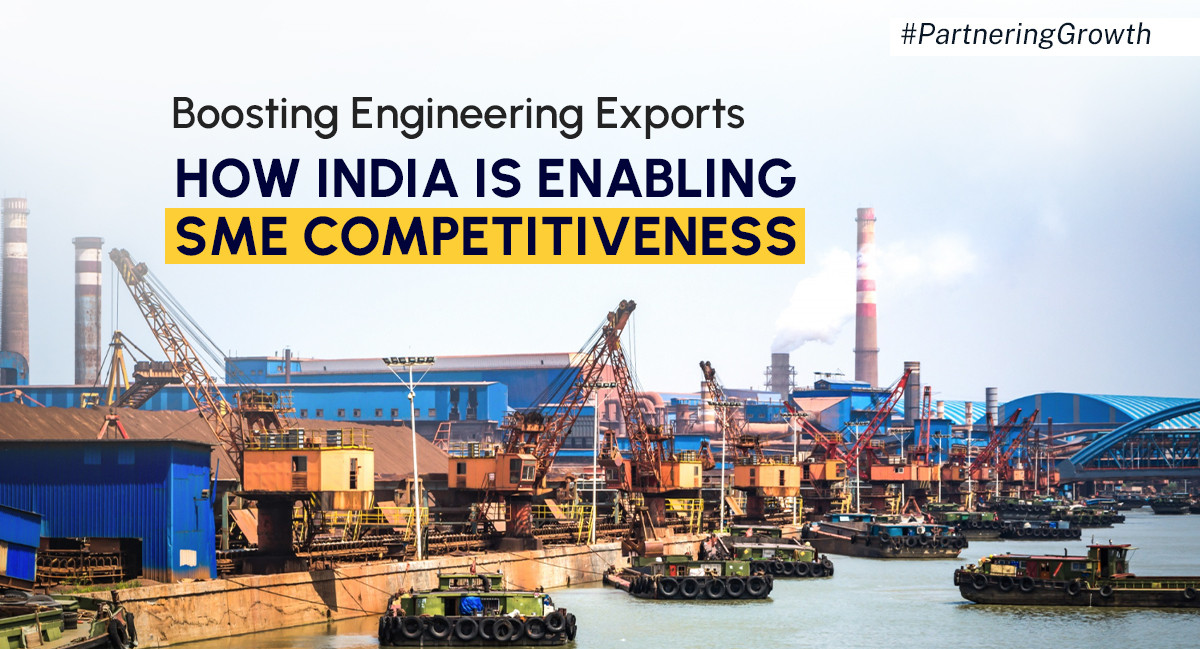
Engineering goods, ranging from industrial machinery to electrical equipment, form one of India’s largest export baskets, accounting for nearly 25% of merchandise exports as per the Ministry of Commerce data as of July 2025. Within this, the capital goods segment drives both value and technological sophistication. From a macroeconomic lens, the sector’s export performance is closely linked to India’s manufacturing vibrancy, forex stability, and integration with global supply chains.
Yet, export competitiveness is heavily dependent on the strength of SMEs, which make up over 70% of engineering exporters. Their challenges—working capital intensity, compliance complexity, and scale-related cost disadvantages—often restrict their ability to serve global markets consistently.
From a financial standpoint, MSMEs face a higher cost of capital, shorter credit cycles, and constraints in hedging foreign exchange exposures. Margin sensitivity becomes particularly pronounced when commodity-linked raw materials, such as steel and copper, show volatility. As reported by the Ministry of Heavy Industries in August 2025, raw material price variability accounted for nearly a 4–6% impact on margin planning across machine and equipment manufacturers in Q2 FY26.
Policy Measures Strengthening Competitiveness
Policy responses in the July–October 2025 period have been notably supportive. The Ministry of Commerce expanded its Export Credit Insurance enhancements and streamlined documentation under ICEGATE to reduce procedural delays. Additionally, the updated PLI-linked supply-chain strengthening schemes aim to improve domestic availability of critical components, reducing import-led cost spikes for SME exporters.
The push toward industrial automation and digital adoption, highlighted by DPIIT’s 2025 Industry 4.0 roadmap, encourages SMEs to modernise production lines. From a compliance perspective, automation not only boosts output but also strengthens traceability and quality documentation—key for meeting global QCO and CE certification requirements.
Beyond this, the Directorate General of Foreign Trade (DGFT) also widened the scope of risk-based approvals under the revamped Foreign Trade Policy framework, reducing processing time for advance authorisations and export obligation documentation. Parallelly, the government’s ongoing work under the National Logistics Policy—especially the fast-tracking of unified cargo tracking and electronic gate systems—has strengthened shipment visibility for exporters handling high-value engineering equipment.
On the financing side, the recent recalibration of interest equalisation support for MSME manufacturers has lowered the cost of post-shipment credit, easing cash-flow pressures for capital goods exporters. Additionally, DPIIT’s push for domestic testing infrastructure—particularly for electrical and industrial machinery—has reduced dependence on overseas certification, cutting both time and compliance costs for SMEs aiming to enter new markets.
Logistics and Infrastructure Upgrades
Infrastructure improvements also feed directly into export competitiveness. Upgrades in ports, multimodal logistics, and faster customs clearance reduce shipment time and improve reliability—factors that carry substantial financial implications for SMEs working on tight delivery margins. For capital goods exporters, this is especially relevant because engineering consignments are high-value, bulky, and often tied to project-specific delivery windows. Recent priorities outlined by the Ministry of Heavy Industries and the Ministry of Commerce emphasise port modernisation and dedicated freight connectivity, helping integrate manufacturing clusters with export gateways.
From a financial viewpoint, shorter dwell times lower warehousing expenses, while predictable transit cycles improve working capital planning, an area where engineering SMEs typically face strain due to long receivable cycles. Streamlined customs processes also reduce compliance uncertainty, enhance documentation accuracy, and minimise demurrage risk. Combined, these improvements strengthen India’s credibility in global tenders, allowing smaller capital goods manufacturers to compete more effectively on both cost and delivery reliability.
What stands out is India’s layered approach: financial support, quality standardisation, localisation of critical components, and logistics improvements. For finance professionals analysing SMEs in the sector, the emerging picture is clear—export competitiveness is no longer driven by cost efficiency alone but by compliance readiness, technology adoption, and resilient working capital planning. If these shifts sustain, engineering exports could become a far more significant pillar of India’s long-term manufacturing growth story.

 Uploaded On:
  Author: