

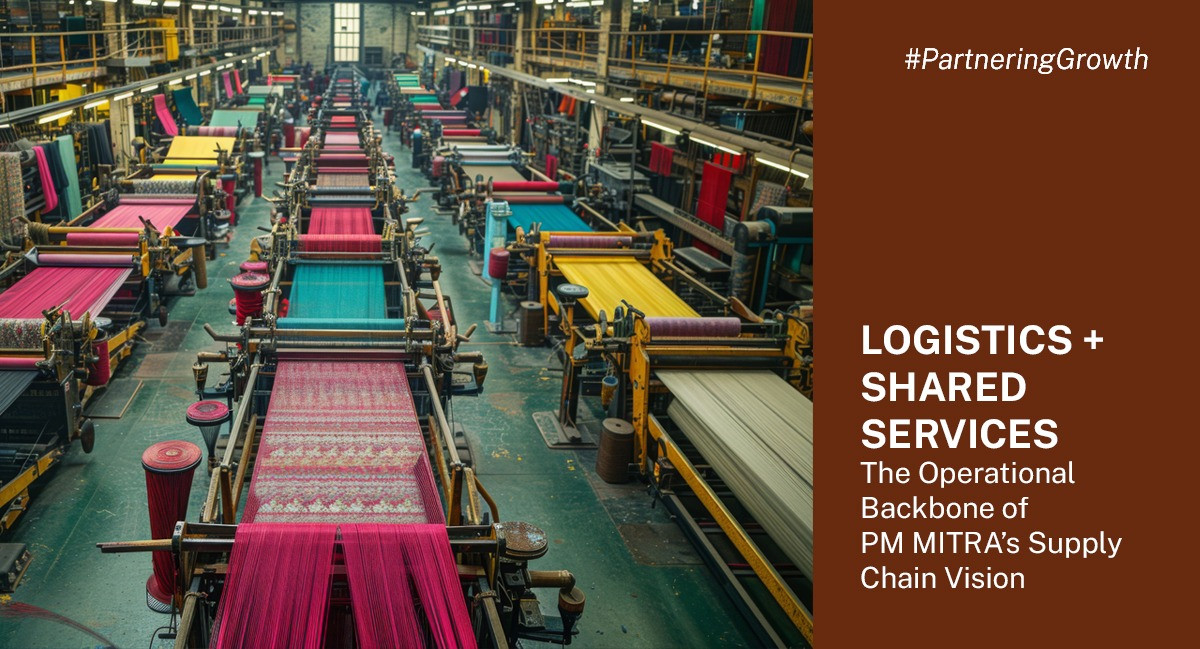
India’s textile strategy entered a new phase with the operationalization of PM MITRA parks, designed to integrate spinning, processing, and garmenting with world-class logistics and shared services. From an economic standpoint, this model marks a decisive shift from fragmented manufacturing to consolidated, high-efficiency ecosystems—an approach increasingly necessary as India positions itself within competitive global supply chains. The Ministry of Textiles’ 2025 updates indicate that integrated value-chain design is expected to materially reduce logistics time and cost across multiple stages of production.
PM MITRA as a Supply-Chain Rationalisation Framework
What stands out is that PM MITRA is not merely an infrastructure creation programme; it is a supply-chain rationalization framework. Logistics and shared services, testing centres, dye-house utilities, automated design studios, warehousing systems, and digital compliance nodes form the operational backbone of these parks. For exporters, whose competitiveness is closely tied to forex-sensitive margins and compliance readiness, these efficiencies directly influence financial outcomes.
Export Performance in 2025: Why Efficiency Matters Now
This is particularly relevant in 2025, when India’s textile exports have shown clear momentum: Textile exports grew 5.37% YoY in July 2025, taking April–July exports to US$12.18 billion, a 3.87% increase year-on-year. For the broader April–September 2025 period, textile and apparel exports together reached US$17.74 billion, marginally up from US$17.67 billion last year.
Within this, textile exports softened 1.85% to US$9.97 billion, while apparel exports rose 3.42% to US$7.76 billion. September 2025 saw a temporary dip, with textile and apparel shipments declining 10.45% and 10.14% respectively. Notably, exports to 111 countries grew 10%, supported by diversification efforts, even as tariff pressures in markets like the US influenced volumes.
Working Capital, Cash Cycles, and Infrastructure Efficiencies
From a financial viewpoint, the sector’s working-capital intensity remains high. Credit cycles for processing and export-driven units often stretch 60–90 days, and inefficiencies in logistics multiply inventory-holding pressures. Shared logistics hubs within PM MITRA parks improve order visibility, accelerate dispatch schedules, and reduce buffer inventory requirements—thereby easing cash-flow constraints. At the same time, shared effluent treatment plants, testing systems, and power infrastructure lower capex obligations for smaller units, which traditionally struggle to build and maintain standalone compliance assets.
Macro-Economic Relevance of the Textile Sector
The PM MITRA framework also aligns directly with India’s export-competitiveness goals. Textiles remain a critical component of India’s external trade structure, accounting for about 8.63% of merchandise exports in FY 2024-25. More broadly, the sector contributes 2.3% of India’s GDP and nearly 13% of industrial production, according to the latest official estimates available in 2025. These numbers illustrate why modern supply-chain infrastructure—including logistics corridors and shared-service centres—is essential not just for firm-level efficiency but for sustaining India’s manufacturing performance.
From a regulatory standpoint, shared testing and finishing centres within PM MITRA parks help units meet increasingly stringent global buyer requirements on restricted substances, labour documentation, and ESG-aligned reporting. Shared digital-compliance modules reduce duplication of documentation, improve audit-readiness, and strengthen transparency across the supply chain—capabilities that are rapidly becoming prerequisites for continued export access.
The Road Ahead
Looking ahead, the success of PM MITRA will depend on the operational robustness of its logistics and shared-service architecture. In my view, the next 18–24 months will determine whether the integrated-park model can successfully compress lead times, reduce cost volatility, and strengthen India’s position as global brands diversify their sourcing. For finance and supply-chain professionals, monitoring how these parks influence margins, capex planning, and risk-management frameworks will be central to assessing the sector’s evolving competitiveness.

 Uploaded On:
  Author: