

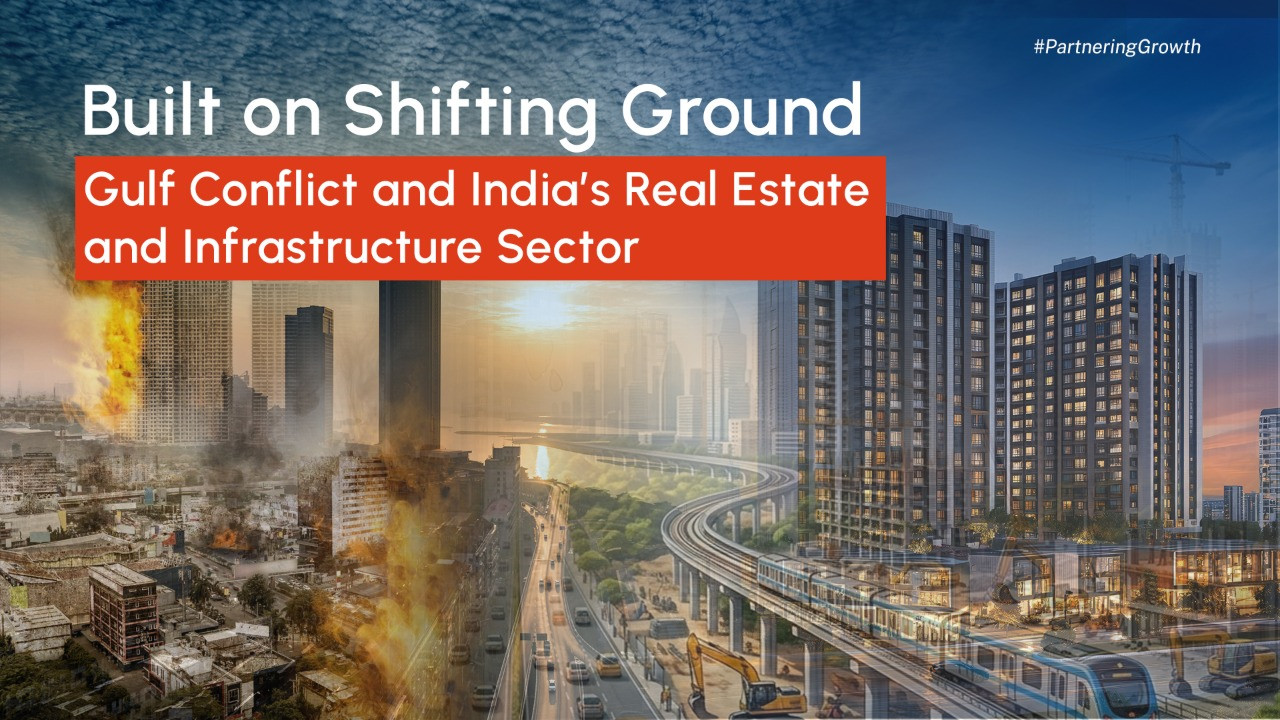
The ongoing geopolitical disruption in the Gulf region is beginning to affect India’s real estate and infrastructure sector through a combination of rising construction input costs, execution pressure on fixed-price projects, and a more cautious financing environment. For a sector built on long timelines and tight cost assumptions, these changes can alter project economics well before they become fully visible in reported earnings.
Rising Input Costs and Project Viability
Capital-intensive sectors such as real estate and infrastructure are highly sensitive to movements in steel, cement, and energy-linked inputs. Where global energy prices rise in response to supply disruptions, the cost of these materials may increase, as reflected in sector updates by agencies such as ICRA and CareEdge (March 2026).
For developers and contractors, this creates a structural issue. Projects, particularly infrastructure and EPC contracts, are often bid and priced well in advance. Where escalation clauses are limited or absent, increases in input costs may not be fully passed through, directly affecting margins and, in some cases, project viability.
Execution Pressure on Fixed-Price EPC Contracts
The impact is most visible in fixed-price EPC contracts. Contractors may face cost overruns arising from higher material and logistics costs while continuing to operate under pre-agreed contract values.
In addition to margin compression, delays in execution may increase exposure to liquidated damages and contractual disputes. For companies executing multiple projects simultaneously, these pressures can accumulate and affect overall financial performance.
Supply Chain Disruptions and Project Delays
Global logistics conditions can add further complexity. Where shipping routes are affected, rerouting via longer routes such as the Cape of Good Hope may extend transit times, as noted in global trade commentary from the World Economic Forum and Deloitte Insights (March 2026).
Infrastructure and real estate projects often depend on imported components such as electrical systems, elevators, façade materials, and specialised equipment. Delays in such inputs can disrupt project sequencing, extend completion timelines, and increase indirect costs.
Funding Constraints and Capital Allocation Decisions
The financing environment may also become more cautious in periods of geopolitical uncertainty. Lenders and investors may reassess risk exposure, potentially delaying financial closure for new projects or tightening conditions for ongoing ones.
Beyond greenfield investments, the more immediate issue lies in funding ongoing projects. Cost overruns may require additional financing, while slower execution can affect cash flows and debt servicing. This can create pressure on working capital, project drawdowns, and covenant compliance.
Divergence Across Real Estate and Infrastructure Segments
The impact is not uniform across the sector. Fixed-price infrastructure and EPC contracts may be more exposed in the near term, while certain real estate segments may demonstrate relative resilience.
Market commentary from Knight Frank and JLL suggests continued institutional interest in India, particularly in office and premium residential assets. However, such trends may vary depending on market conditions and should be assessed in the context of evolving investor sentiment.
Closing Perspective
The sector operates on long timelines, but the assumptions underlying those timelines can shift relatively quickly. Changes in cost structures, execution timelines, and financing conditions can influence project economics well before outcomes are reflected in financial results.
In this context, reassessing project viability, financing structures, and contractual safeguards becomes increasingly important. It would be useful to understand how practitioners in the sector are approaching these decisions

 Uploaded On:
  Author: